From Réunion Island to Todai
A jack-of-all-trades, master of none, but oftentimes better than a master of one. Game designer who dabbles in arts, writing, AI, research and music.
F.S.
- Childhood
Réunion Island
A very small island in the Indian Ocean, east of Madagascar.
I’m French, but I’m from “tropical France”, as one of my friends likes to say.
- 2005
École Supérieure des Beaux-Arts de La Réunion
Bachelor of Arts. Animation directing and storyboard with Georges Lacroix; a workshop on sensors with Michel Geiss.
I was always guided by creativity. There I learnt argentic photography, music mixing, installations, book binding, product design.
- 2006–2011
Shaamans
Guitarist and lead vocalist.
- 2008
ILOI, Le Port
Institut de l’Image de l’Océan Indien. Game design; I composed the soundtrack of our student game, Parasomnia.
The hero was a young orphan who could jump into the dreams of his friends, cursed by the magic of Hecate, the goddess of nightmares.
- Japan
Internship at Wedovideo
Motion design, camera, video editing.
It was during this internship that I basically fell in love with Japan!
- 2010
Art and animation instructor, ILOI
Colour theory, storyboarding, character design, animation techniques, human anatomy.
It was as enriching for me as a teacher as it was for them as students.
- 2014
The Intrinsic Semiotics of Video-Games
A short thesis, published on Kindle.
I still wanted to make games, so I took some time to write about them. My essay opened the doors of Todai to me.
- 2015–2017
The University of Tokyo
In Professor Akira Baba’s game lab (the lab closed in 2017).
- 2016
Connectionist AI
Machine Learning by Stanford on Coursera, taught by Andrew Ng. Also the year of the essays on ludophrases and ludonarrative dissonance.
Since 2016 I have been studying AI, and especially connectionist AI, seriously.
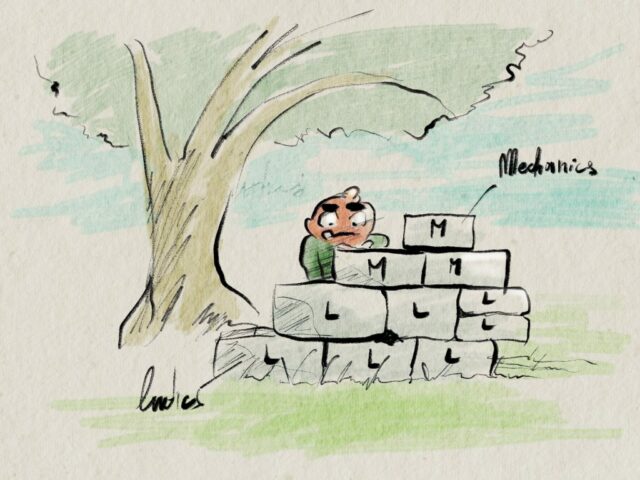
Ludics before mechanics, a sketch for the essay Ludophrases, 2016. - 2017–2018
Professor Takeshi Okada’s lab
A year in Professor Takeshi Okada’s cognitive science lab. In 2017, the Deep Learning Foundations Nanodegree on Udacity.
I studied cognitive science there, and my interest in connectionist AI deepened, especially after Dr. Tomasz (Tomek) M. Rutkowski trained me to interpret EEG signals.
- 2018
The RCA-IIS (now DLX) Design Lab, and Jason G. Karlin’s lab
Joined the RCA-IIS Design Lab with Miles Pennington, and Jason G. Karlin’s lab for the philosophical side, researching AI empathy. The same year, the Artificial Intelligence Nanodegree on Udacity.
- 2018
Luminous Productions (formerly of the Square Enix group)
AI game designer in pre-production on a AAA title, 2018 to 2022, under Lead Game Designer Prasert Prasertvithyakarn (Sun-San). I prototyped AI templates and designed AI systems and architectures for the programmers to implement. I wrote game design concept proposals and did level design, including some of the worldbuilding that came with it. I also sketched NPC pre-concepts to plan the resources they would need, and even ran some fantasy conlanging experiments.
- 2023
KLab
Senior Technical Game Designer.
At KLab I am building the AI stack for game development, and developing new IPs that make use of connectionist artificial agents.
- 2025
Ph.D., The University of Tokyo
Also associate researcher at IMSIC (Aix-Marseille Université, Université de Toulon).
Thesis defended: Emergent Languages: Game Design for Communication with Artificial Agents.
- 2025
Associate researcher, IMSIC
Aix-Marseille Université, Université de Toulon.
I am trying to start research initiatives about videogame AI in my hometown of La Réunion.
- Now
I am interested in the ways connectionist AI will make new game concepts emerge, and in the design methods that let us designers, as cybernetists, try to tame the chaos both within and without the game experiences we make.
Press
Réunionnais du Monde ·
Frédéric Séraphine, concepteur de jeux vidéo à Tokyo
A portrait of the path from La Réunion to game design and AI research in Japan.
Kotaku
The BioShock Problem: When Gameplay And Narrative Clash
A video essay on how gameplay and narrative clash.
Play
If you are a researcher who would like to collaborate or contribute to my research, please feel free to contact me.