When game designer colleagues first told me about shibari play, I was not entirely sure the conversation belonged in the workplace. If you are now wondering whether it belongs on a game design blog, don’t worry.
It does.
In Japanese, shibari refers to binding or constraints. In a game, we impose those constraints on ourselves: refusing to level up, removing our armour, or deliberately weakening our character.
Usually, we do so because we want to make the game harder. The restriction is part of the pleasure, and overcoming it gives the victory a particular flavour. However, what happens when the way we enjoy playing already puts us at a disadvantage? Can following what seems to be the game’s purposed playstyle become a form of shibari play in itself?
My experience with Armored Core VI made me wonder about this.
Give me a garage full of robot parts and I will spend an unreasonable amount of time trying to build something that feels like mine. In Armored Core VI, the choice of parts changes how fast I move, how high I fly, how quickly I can use a sword, how much ammunition I can carry. Especially in its solo mode, I take that abundance as an invitation: imagine a machine, find a style, see what it can do. Eventually try to do so while making it look good…
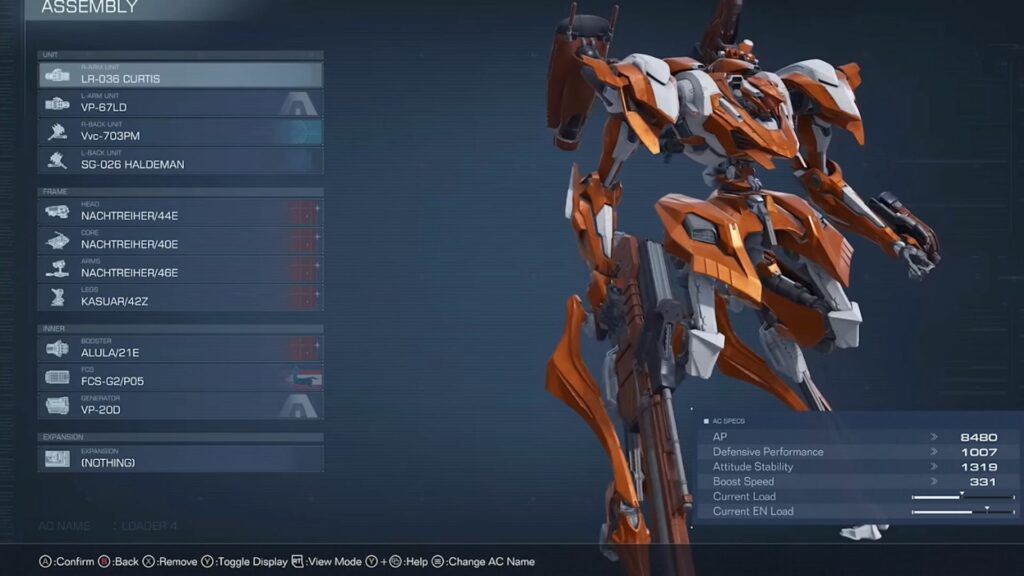
Then take that machine into a competitive match. If a few combinations win more reliably than the others, there is a price for insisting on your own invention. A strange reversal happens. What looked like the ordinary pleasure of the game becomes a voluntary restriction. I can still use my robot, but refusing a more efficient one makes winning harder. I have turned playing as I believe the game invites me to play into shibari play.
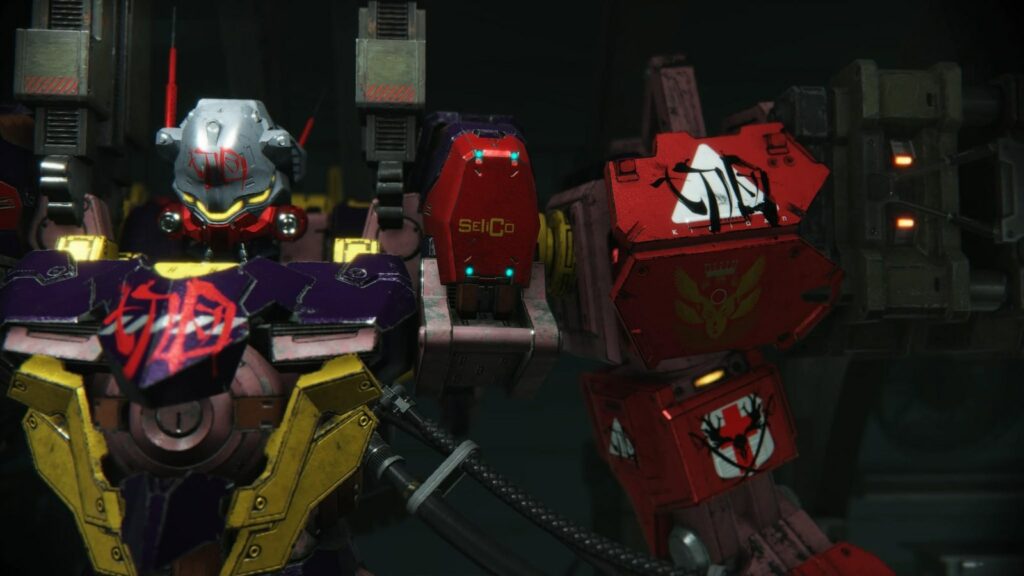
That reversal interests me because the meaning of a difficulty depends on the experience in which it appears. A rule gives you a possibility, an obstacle, perhaps a punishment. The order in which you encounter those things gives them meaning. If I want a player to feel vulnerable, I could simply make every enemy dangerous. But if danger is all the player has ever known, how do I know they will read that feeling as vulnerability? They may only conclude that my game is punishing, or that I have balanced it badly. I have to give power a place in the experience too, before or after the loss of it. The order changes the story.
Metroid can begin by letting you feel the weight of your full equipment, and then take it away. The absence has a shape because you remember what occupied it. Another game could let an NPC carry you through a fight, showing you a power you do not yet possess. Or it could offer a few easy enemies before placing a fierce foe in your path, a foe you are expected to lose against. These are different ways of composing the same contrast. One lets you mourn a lost capacity; another lets you glimpse a future one; another lets your early confidence walk straight into a wall. That wall can be the point.
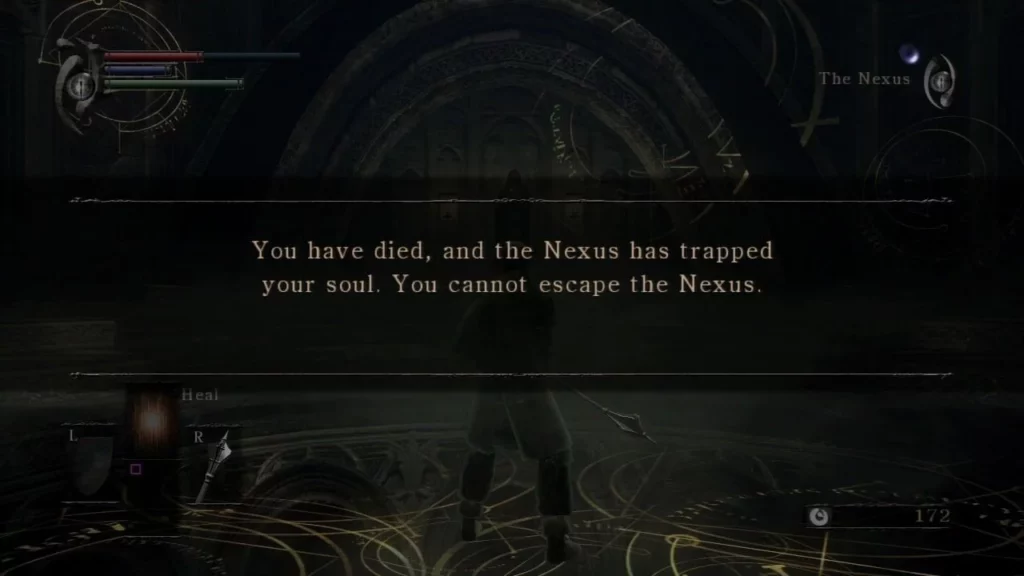
The opening defeat in Demon’s Souls is a kind of hazing. You are killed, and the game continues instead of giving you a game over or a second chance at battling the foe. It has admitted you to its cursed world by knocking you down at the door. Later, in a Souls game or Elden Ring, on a new game plus, you can meet again that initial boss that once made you feel helpless and roll over it with everything you have learned. Perhaps sixty hours have passed. The rematch feels rewarding because you remember the humiliation. The first defeat and the later triumph speak to one another across the whole odyssey.
The experience accumulated by the player and the experience accumulated by the character can both contribute to that victory. Some players want to know how much came from learned skill, and how much from levels, armour, equipment, numbers. So they refuse to level, fight naked, or choose an item that makes them weaker, like Shabriri and Daedicar’s woes (one making you an enemy magnet and the other making you take double damage). This is shibari play in its clearer form: the game permits the restriction, while the player chooses it for the particular pride of overcoming a harder problem. Although, most players can be proud of winning with a levelled character in armour! These games are punishing enough already.
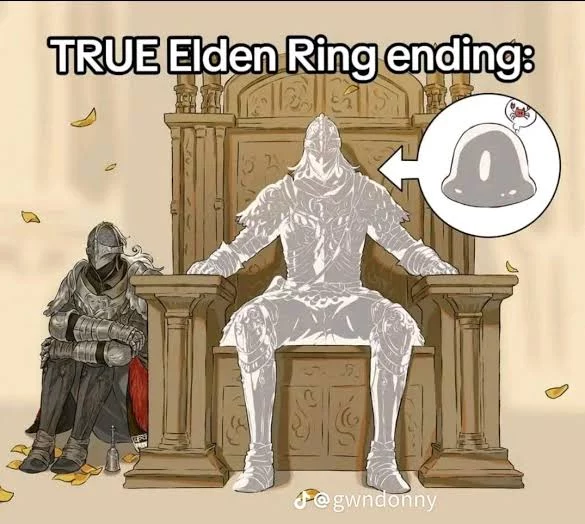
And yet the pride of the challenge runner can become a little tribunal. You know the usual joke about the Elden Ring player who used a summon or Mimic Tear in its path towards defeating the Elden Beast: perhaps the Mimic Tear should sit on the consort’s throne instead. I can laugh at it, up to a point. Once it becomes a way of denying that another player won at all, the community has started imposing its preferred version of the game on somebody else’s experience. In a mostly solo adventure, that player can often leave the tribunal outside the door and enjoy the game anyway. An online opponent enters the room with you.
Those differences in perception matter when we ask players to assess a game. A tester may welcome a difficulty they chose, resent one they feel forced to accept, or judge their performance through a standard learned from other players. Their answer to “Did you like it?” can carry all of that, without telling us which part we are actually measuring.
Of course, if a new feature delights players and does not completely betray what we intended, it may belong in the game. But before drawing conclusions from a playtest, we need to understand the conditions that produced the response. A good feature can be discarded because the test never gave its effect a chance to appear. Show people only the painful part of an experience designed around the passage from power to vulnerability, and what are you testing? Their response to pain, perhaps. The passage itself has disappeared.
I would treat such a test more like a psychology experiment. Let one group experience only the punishing section. Give another power first, then punishment. Reverse that order for a third group. Give a fourth a more balanced piece of play for comparison. The point is not to make every tester endure all four versions; it is to isolate the contribution of the contrast, and of its direction, to what they feel. How do they describe their weakness? Does it feel intended? Does the return of power mean anything different after they have been deprived of it? A crude approval score could miss all of this. The player has told us something, but we have asked the wrong question.
Now back to the garage. Armored Core VI gives me parts and parameters enough to imagine thousands of machines. Competition begins to sort them. There were efficient dual Zimmerman shotgun builds early in the game’s life; the Zimmerman was later adjusted, and other combinations took their turns. I remember builds exploiting the way opponents aimed while a robot was falling. The particular solution can change with a patch, but the hunt for a solution does not stop. Find what wins. Copy what wins. Meet it again.

Ranked play came later. From what I saw, A and S rank could seem populated by three or four types of build at most, despite all the combinations the garage offered. B rank was probably the highest place where the fun of experimenting still survived. There you could meet someone who had made a machine for the pleasure of discovering what it did. There, too, a copied meta build felt particularly irritating: it arrived in a place where another way of playing was still trying to breathe.
The selection pressure is easy enough to understand. Promotion demands wins. If a robot someone enjoys using loses too often against the strongest common setups, its pilot can remain in B rank while the pilots using those setups rise. The game has not forbidden my invention. It has given it a cost. At some point the player who is doing what the parts seemed to invite has become the one accepting a handicap. Playing as intended becomes shibari play, with no solemn vow and no naked character, just an obstinate affection for a machine I made myself.
Still, competition alone could produce much of this. Even without a Discord server or a YouTube video, players can discover effective builds, imitate opponents, and converge. The stronger combinations are there in the rules. If everyone eventually finds them by playing, I cannot blame an outside community for creating the result. But I suspect that the speed of convergence, and therefore the time players have to enjoy their own experiments, can change drastically when information travels beyond the matches.
I would call that possible outside contribution social xenodynamics: social interactions beyond the game introducing a dynamic into the game people actually play. Someone explains an efficient build on YouTube or Reddit. Players on Discord refine it. Thousands of similar robots can then appear in matches, while someone who has never joined those conversations must still fight their products. To that player, the arena can feel full of clones arriving from nowhere, one after another, until trying something personal begins to feel like being bullied. The winning combination existed in the software; the route by which it reached so many opponents did not.
A shared build is like a thread of Ariadne for a player lost among thousands of possible parts: it points to a way through. Following this thread is not wrong in essence but… Everyone following the same thread may make other passages of the maze completely unexplored, narrowing the possibility space. How much of the narrowing belongs to the design of the maze, and how much to the speed with which knowledge of the thread is passed from hand to hand? I don’t think looking at a crowded ranked mode after release can answer that by itself.
We could begin to investigate it even during alpha, with a small, carefully arranged multiplayer test. Give one pool of players a place to communicate, perhaps a Discord server, and let them play together. Give a second pool no such channel, but let them encounter the communicating players in matches. Then create a third, separate pool: its members have no supplied communication channel and play only one another. The experience of this isolated third pool will be the “pure” experience for the purpose of this comparison.
The two pools without a communication channel matter for different reasons. In the second, players can learn from what the communicating pool brings into the match, even though they never enter its conversations. In the third, they can only learn and adapt within their isolated pool. Comparing those two groups could show whether contact with a communicating community changes the experience of players outside that community. I would watch what builds they adopt, how quickly they adopt them, how many different approaches remain in play, and how they describe the pleasure or frustration of their matches. This is a separate experiment from the four versions of power and vulnerability: here the variable of interest is exposure to an outside conversation.
I would expect the exposed players to begin copying winning strategies they encounter. I would be more surprised if the isolated players reached the same narrow set just as quickly. That would point strongly toward a dynamic already driven by the competitive game. But even if all three pools eventually arrive at similar builds, the outside communication would still matter if it brings the exposed players there significantly faster. The final collection of robots might look the same while the months, weeks, or hours in which other inventions could survive have been compressed.
Perhaps the thread turns out to be mostly a guide through a maze that was narrow from the start. Perhaps passing it between players makes the maze narrow long before it had to. Either answer would tell us something useful about how to design, test, and preserve the pleasures we claim to offer. For now I return to the garage, to all those parts still promising a machine I can call my own. I would like to know how far it can walk before the thread becomes a cord around its ankles.
See also: the “xeno” in social xenodynamics comes from the xenoludics of The Ludic Framework.